The choice between wood and melamine is not noble versus practical. It is two manufacturing logics, two ways of behaving in the light, and two budgets that overlap more than you might think. Here is what really sets these two families of fronts apart.
Real wood: a living material, demanding to fit
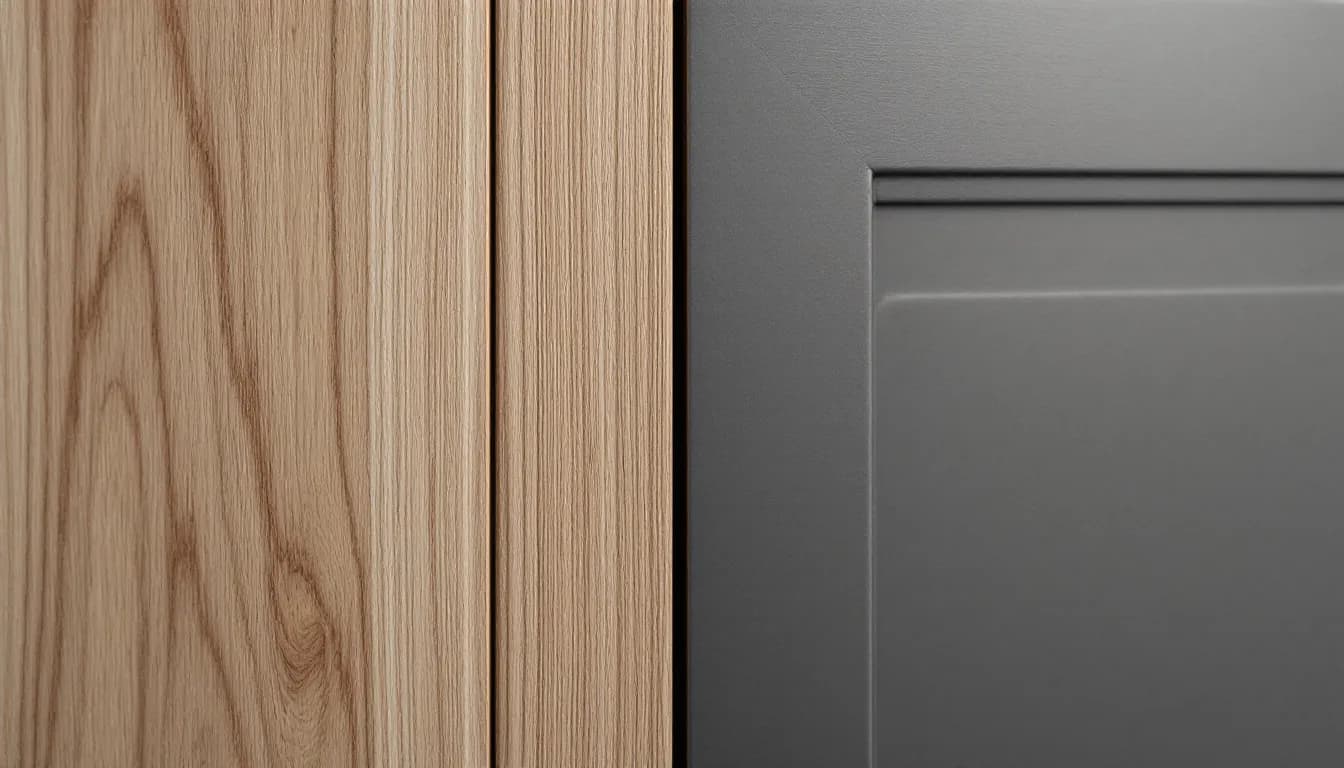
A front in solid wood or real wood veneer keeps the memory of the tree. The grain is unique, the tone shifts with the light, and the surface reacts gently to the room's changes in humidity. It is this breathing quality that gives oak, walnut or eucalyptus kitchens their tactile warmth.
Real wood veneer, applied to a laminated panel, offers greater dimensional stability than solid wood while keeping the look and feel of a natural species. Today it is the most common solution in high-end kitchens. Solid wood remains reserved for certain crafted pieces, such as integrated handles or visible structural elements.
When it comes to upkeep, oiled wood needs an annual top-up. Varnished wood wipes clean with a soft cloth and copes well with splashes, provided you avoid abrasive detergents.
High-density melamine: an underrated technical performance
Contemporary melamine has little in common with the entry-level panels of the 1990s. High-density melamines, structured or textured, faithfully reproduce the material they imitate: oak grain, walnut figure, stone, concrete. The protective layer resists scratches, heat up to a point, and everyday stains.
Melamine's main strength remains its stability. The fronts do not move, the joints stay crisp, and the regularity of the edges allows perfectly aligned integrated handles. It is also the material that opens up the widest colour palette, from snow white to deep greys, by way of contemporary material effects.
A comparison on the criteria that matter
Real wood
Veneer or solid
- Unique grain, tactile warmth
- Patina that shifts with the light
- Regular upkeep (oiled or varnished)
- Higher budget, strong perceived value
High-density melamine
Technical panel
- Perfect dimensional stability
- Highly resistant to everyday stains
- Wide palette of tones and textures
- Unbeatable price-to-performance ratio
Neither one wins on every front. The real criterion is use: a family with young children, a kitchen open to the living room, how often you cook, and exposure to natural light. This logic of use runs through our method for choosing all the materials in the kitchen, where the fronts are always decided before the worktop.
The question of light
A wood front responds to overhead lighting by revealing its grain. A lacquered or matt melamine front absorbs light evenly. A structured melamine front creates micro-shadows that bring the surface to life.
This behaviour in the light is rarely obvious in a catalogue. It is in the showroom, under real lighting, that you sense what will suit your room.
In practice
Rather than setting wood against melamine, the most solid approach is often to combine them: an island in oak veneer, wall units in sand melamine, tall units lacquered in ink. The design then remains that of a kitchen, not an assembly of products, provided all the finishes rest on the same modular base. This is precisely what programmes such as Snaidero Sistema make possible, bringing together lacquer, wood and melamine on the same technical platform. The essential point still holds, whatever the manufacturer: each finish reacts differently to light, and it is on full panels, in your own room, that the right match is confirmed.