The corner of a kitchen is the place where geometry stops cooperating. Two units meet at a right angle, and behind the junction hides a precious volume which, if poorly thought out, becomes a black hole. Italian designers long ago turned it into a field of discreet engineering, where mechanics make up for what perspective forbids.
Modular corner mechanisms
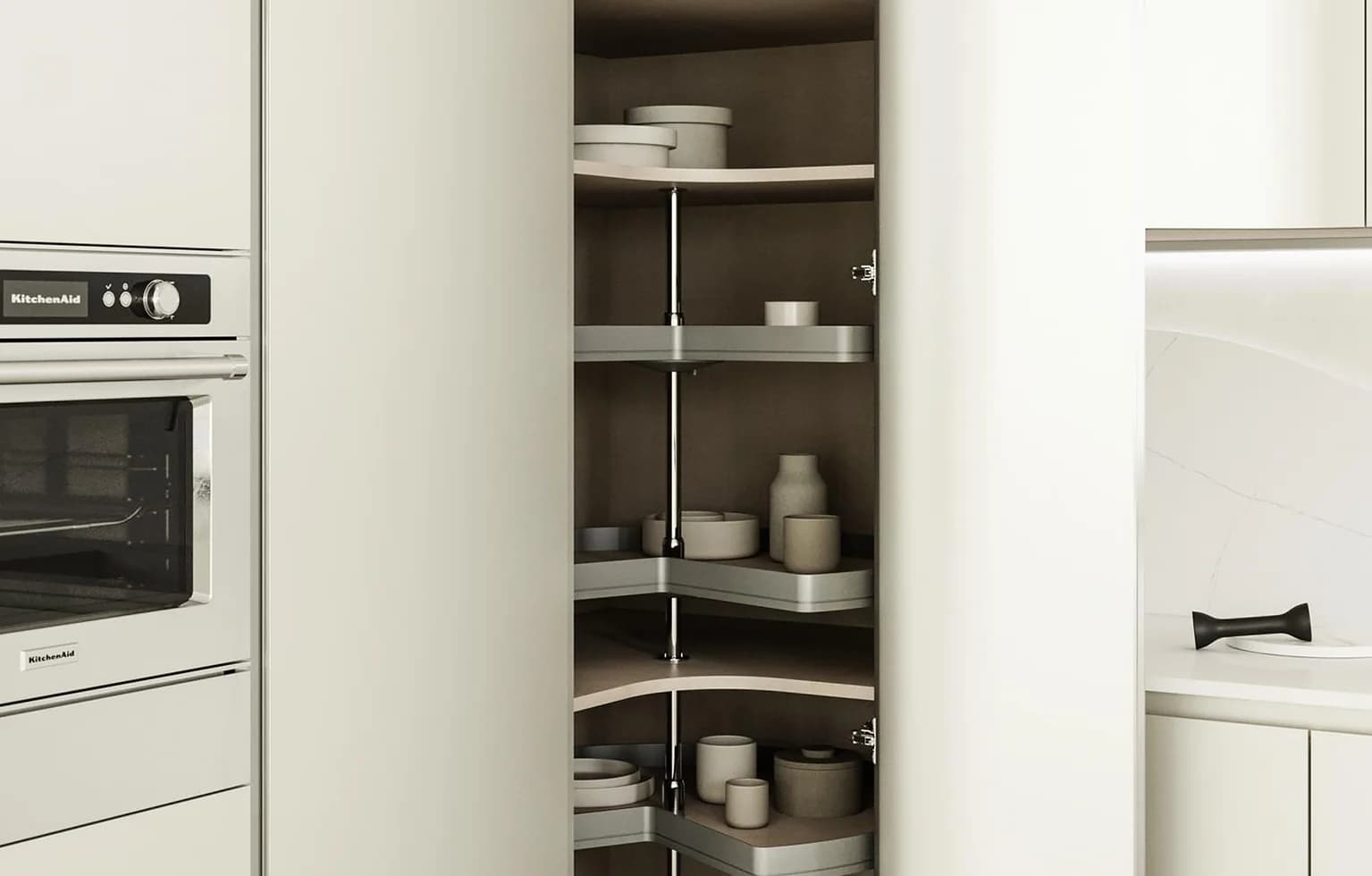
- LeMans swinging column, layered rotating trays for tall columns
- Magic Corner pull-out, hinged twin baskets that extract simultaneously
- TournUS swinging tray, rotation and movement out of the carcass
- L-shaped drawer, a single front that clears the whole low corner volume
- Carousel shelf, a twin disc for everyday under-worktop storage
Understanding the geometry of a corner unit
A classic corner carcass often measures 90 by 90 centimetres at floor level, sometimes more. The visible front occupies only a fraction of that volume, and all the space behind the hinges becomes inaccessible if you stick to a fixed shelf. The first rule, then, is to think in terms of volume rather than surface area. The deeper the carcass, the more the internal storage must swing, slide or extract. The second rule concerns the direction it opens. A door that opens towards the passage hampers circulation; a door that opens towards the wall frees the work triangle. This logic then guides the choice of mechanism.
Swinging trays for the lower units
Beneath the worktop, the swinging tray remains the most reliable solution for reclaiming a low corner. The principle is old, the result modern. A central axis carries two stacked discs in lacquered metal or compact wood, and each disc brings the utensils towards you in a single movement. Well sized, it holds pans, casseroles, mixers and small appliances without leaving anything at the back. The most accomplished models combine rotation and movement: the tray swings, then slides out of the carcass. You then take in the contents at a glance, without having to bend down.
Smart columns and drawers
For corner columns, two families dominate. The mechanism known as the Magic Corner deploys two baskets mounted on an articulated arm: the first comes out as you pull the door, the second follows it, swinging from the back. Together they give access to the entire volume with no wasted movement. The second mechanism, taller, is the LeMans-type swinging column, whose rotating trays allow vertical, layered storage. Spices stay up high, heavy packets go down low, and each level swings independently. In both cases the runners are soft-close: the opening is generous, the closing silent.
High corners, often forgotten
High corners, above the worktop, raise the same question as low ones, with even more awkward access. A fixed corner shelf stays usable if you store there what comes out rarely, such as good dinnerware or dessert services. For everyday use, you prefer side-loading shelves, or integrated lighting that reveals what the shadow usually swallows. The height of the top shelf must stay reachable, even with a low ceiling: a wall unit more than 90 centimetres above the worktop forces you to climb, which makes no sense in a kitchen.
Choosing the right mechanism
None of these devices is universally superior: the right choice depends on the carcass dimensions, the direction it opens and what you actually store in the corner. The swinging tray excels on everyday low corners, the Magic Corner frees the whole volume of a column, the LeMans column organises storage upwards, and the L-shaped drawer offers the most direct view. One last piece of advice applies to all: a corner mechanism is best judged by operating it. Its load capacity, its damping and the smoothness of the runners are assessed by hand, far better than on a spec sheet.
To take this further
Beyond the mechanics, some kitchens do away with the sharp corner altogether. The Ola model, designed by Pininfarina, curves the worktop and slips a curved rotating corner cabinet where others leave a dead recess: the movement becomes continuous, the volume fully accessible. A fine illustration of this principle, worth seeing in the showroom to gauge the smoothness of opening that no spec sheet can convey.