Built-in appliances make the kitchen. They carry out its functions, its rhythm, its day-to-day reliability. They also bear the brunt of the thermal, humidity and grease loads. Their upkeep is no minor detail. It is what sets apart a kitchen that ages well from one that quietly degrades.
The hood, the first thing to maintain
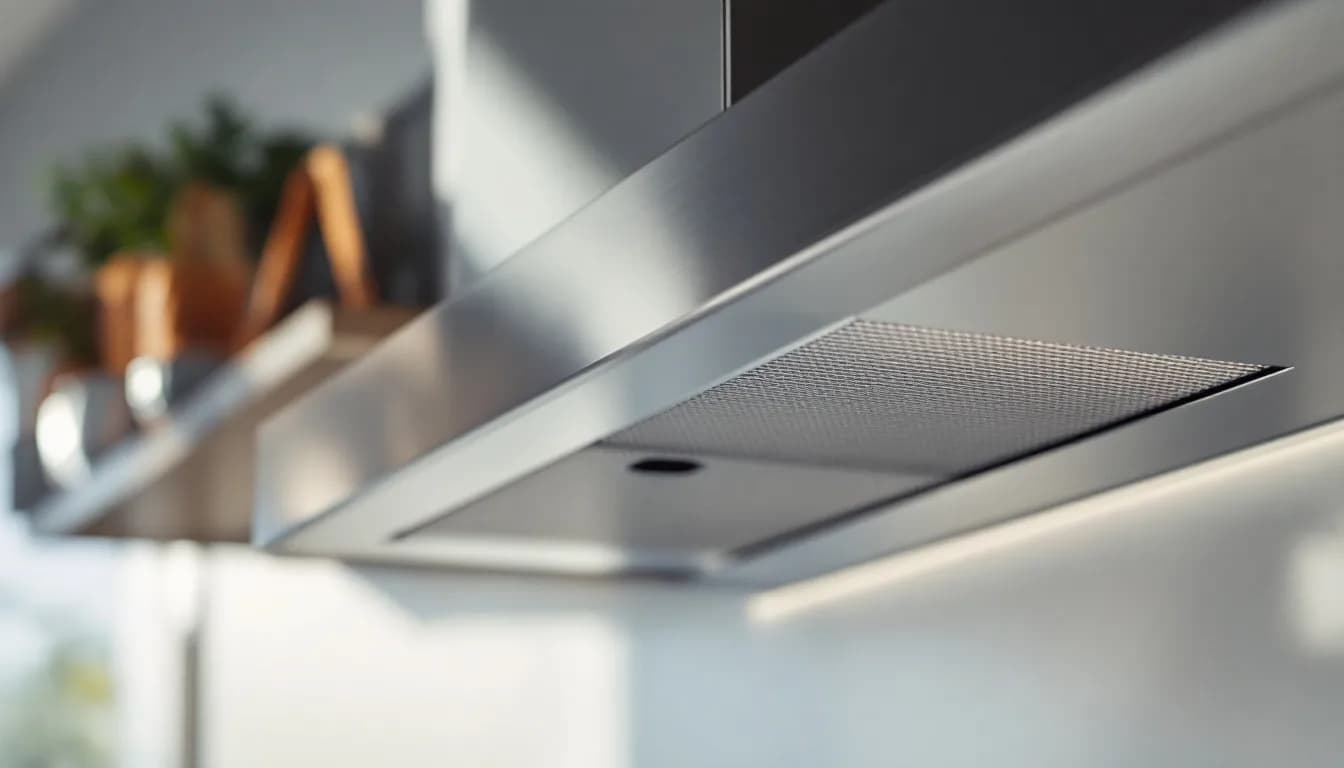
The hood captures grease before it settles everywhere else. Its metal filters saturate within a few weeks of regular use. Take them out once a month, soak them in very hot water with added soda crystals, then run them through the dishwasher on an intensive programme. A saturated filter no longer captures, it redistributes, and compromises the airflow of the whole room. Recirculating hoods also need the active charcoal filter replaced every six to nine months. On brushed stainless steel hoods, wipe the housing in the direction of the brushing, never across it, with a slightly damp microfibre cloth. The glass of angled hoods is cleaned with a window cleaner, avoiding any seepage towards the lighting.
The oven, method by type
Today's ovens fall into three broad categories of upkeep. Catalytic, where porous walls absorb grease during cooking, calls for little intervention but loses its efficiency over time. Pyrolytic raises the cavity to over 450 °C, turns any residue to ash, and then needs only a damp wipe. It is one of the criteria that weighs at the moment of choosing a built-in oven, so much does the cleaning mode shape daily life. Hydrolytic, gentler, generates steam from a pool of water and suits fresh soiling. Whatever the technology, always take out the shelves and the rails to wash them in hot soapy water, and clean the inner glass as soon as a mark appears: a deposit cooked twice over becomes almost impossible to remove.
The dishwasher, the forgotten one in upkeep
A dishwasher that cleans badly almost always has a clogged filter. Unscrew the central filter every fortnight, rinse it under hot water, and scrub the grille with a brush. Check the spray arms: the nozzles get blocked with limescale and bits of label. Once a month, run an empty cycle at 70 °C with a glass of white vinegar placed on the upper basket. This descales the inside, the heating element and the door seal. On the seal, go over it by hand with a non-abrasive sponge: food residue lodges there and eventually starts to smell.
| Appliance | Maintenance frequency |
|---|---|
| Metal hood filter | Monthly wash, dishwasher intensive programme |
| Recirculating hood charcoal filter | Replace every 6 to 9 months |
| Oven cavity and inner glass | Monthly pyrolytic cycle or weekly wipe |
| Dishwasher filter | Brush rinse every fortnight |
| Induction ceramic-glass hob | Lukewarm wipe after each use, dedicated scraper |
| Fridge, seals and condensate tray | Quarterly clean, defrost depending on model |
| Sink and trap | Monthly descale with heated diluted vinegar |
The warming drawer and the small built-in appliances
The warming drawer is cleaned cold, with a damp cloth and a little mild soap. The non-stick coatings on the base tolerate neither scouring agents nor metal utensils. For built-in coffee machines, follow the manufacturer's descaling cycles: a delayed descale wears out the pump and the heating element, which are the most expensive parts to replace. Induction hobs are cleaned while still lukewarm, with a dedicated scraper for caramelised sugars. Avoid abrasive sponges, which scratch the ceramic glass irreversibly.
Maintaining built-in appliances comes down above all to regularity: a filter taken out each month, a descale kept to date, a piece of glass wiped before the deposit cooks twice over. Spread across time, these gestures weigh nothing and protect the parts that are the most expensive to replace.
To carry on
Maintaining the appliances is only half the equation. The other half plays out on the surfaces and the organisation, in a kitchen designed to stay clean day to day. The two logics complement each other: healthy appliances in a space designed to limit the build-up of grime.