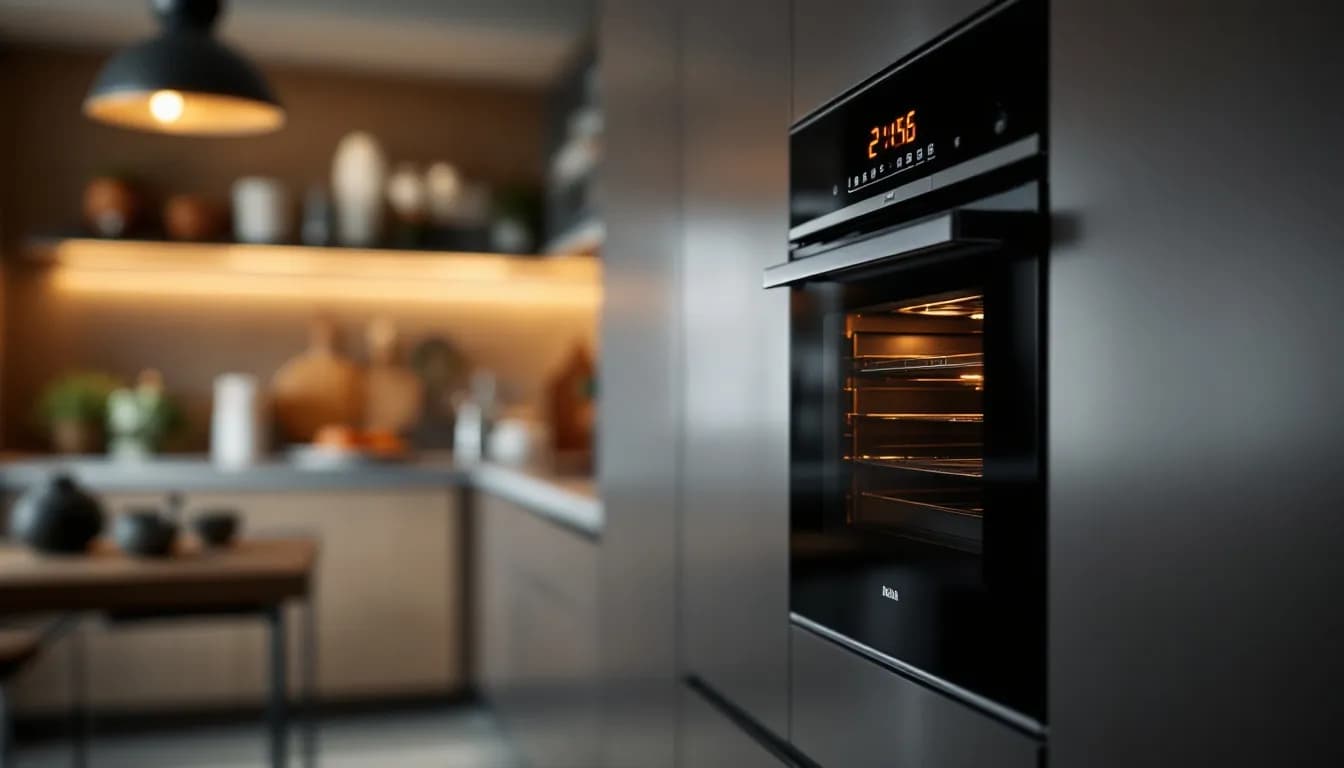
A built-in oven is bought for fifteen to twenty years. It is probably the most structuring appliance in your kitchen, and the one whose poor choice will come back to haunt you the longest. The real criteria come down neither to the energy rating nor to the entry price. They lie in the cooking technology, the quality of cleaning, the thermal precision and the coherence of integration within the cabinetry.
Multifunction, steam or combined: choosing your technology
The multifunction oven with fan-assisted heat remains the baseline. It combines natural convection, forced air and grill, and covers all the classic uses: roasting, baking, gratins. For a household that cooks regularly without chasing maximum performance, it is the most rational investment.
The steam oven adds a sealed cavity and a water generator, which injects pure or modulated steam. Low-temperature cooking, crusty breads, crunchy vegetables and fish without drying out all gain in quality. Reckon on 30 to 50 % more in price than a multifunction oven of equivalent range.
The combined steam oven (multifunction + steam in a single cavity) is the most versatile solution, but also the most demanding to master. The premium brands (Miele, Gaggenau, Siemens iQ700) excel at it. This is also the category where the quality gap between top and bottom of the range shows most.
Pyrolysis
Classic multifunction
- Incinerates grease at 500°C, an immaculate cavity with no intervention
- 1h30 to 2h30 cycle, high energy consumption
- Heavier and better-insulated appliance, reasonable entry price
- Ideal for intensive roasting and everyday baking
Steam
Sealed cavity + generator
- Low-temperature cooking, crusty breads, crunchy vegetables
- Tender fish and meats without drying out
- 30 to 50 % dearer than an equivalent multifunction
- Combined steam oven recommended for maximum versatility
Cleaning: pyrolysis, catalysis, hydrolysis
Pyrolysis raises the cavity to 500°C to incinerate the grease. A full cycle of 1h30 to 2h30, high energy consumption but an immaculate result. It is the easiest solution to live with, provided you accept a heavier, better-insulated appliance.
Catalysis uses self-degreasing walls treated chemically, which absorb splashes from 200°C. No dedicated cycle, but the walls have to be replaced every 4-5 years. Limited effectiveness on baked-on soiling.
Hydrolysis, sometimes called steam cleaning, softens the grease at 90°C with a little water in the base. A short cycle, low energy, but it then requires wiping by hand. Suits light use.
Thermal precision and quiet running
A good oven holds its temperature to within a degree once it has stabilised. Entry-level models swing by 15 to 20°C around the setting, which ruins any demanding baking. Check the integrated core probe, which steers the cooking by the food's internal temperature rather than by timer. On a chicken or a roast, that is the difference between pink and overcooked.
Noise is an often-forgotten criterion. A poor-quality fan oven runs at 55 dB, a continuous background drone for two hours. Quiet models go down to 38-42 dB, almost imperceptible in a kitchen open to the living room.
Built-in fitting and standard dimensions
European built-in ovens follow a standard niche of 60 cm wide × 60 cm high × 55 cm deep, with a rear ventilation clearance of 4 to 6 cm depending on the brand. XL ovens (75 or 90 cm wide) require a dedicated niche and cabinetry sized in advance.
The fitting height determines the ergonomics. An oven fitted 90 cm off the floor avoids bending down and makes it easier to slide in a heavy casserole. It is also the safest height, particularly where there are children.
A built-in oven is therefore chosen in this order: first the cooking technology that matches the way you cook, then the cleaning mode you will accept living with, and finally the built-in dimensions to fix before any joinery. Taking the criteria in the right order avoids the most costly nasty surprise, the one discovered once the unit is already fitted.
To read next
The oven never lives alone in a column: it converses with the microwave, the warming drawer and the coffee machine that accompany it. The same rigour over dimensions applies, for that matter, to the choice of a microwave oven, whose built-in fitting is decided at the same time as that of the traditional oven.